Hokonui Rūnanga Register
  • About us
    • Who we are
    • Murihiku Regeneration
    • Property assets
    • Find us
    • Job vacancies
  • Our history
    • Our whakapapa - a deep connection to this place
    • Wai and Whakapapa
    • The Battle of Waitaramea
    • Poupoutunoa and Kauwaewhakatoro
    • Two Rivers: Mataura (Mata Ura) and Clutha (Mata Au)
  • Events & key dates
    • He Ao Hou - New Futures Murihiku Teacher PD Day
    • Energy and Innovation Wānanga 2024
    • Energy and Innovation Expo 2023
    • Science and Innovation Wānanga 2021
    • Energy, Infrastructure and Opportunities Wānanga 2026
  • Education & training
    • Education - Hokonui Rohe Team
    • Te Ara Aukati Kore - Education, Training, and Capability
    • Have your say!
  • Environment
    • Kaupapa Taiao - Hokonui Floriculture
    • Taonga Research
    • Southern Ocean - Murihiku ki te Tonga
    • Energy Transition Programme
    • Te Tapu o Tāne
    • Our Kaimahi - Staff
  • Health & wellbeing
    • Whānau Ora Navigators
    • Community youth worker and advocacy service
    • Hokonui Community-Led Health
    • Kaumatua Health Days
    • Te Kakano - Nurse-led Clinics
    • Our Kaimahi - Staff
    • Hokonui Takiwā Health and Wellbeing Village of Support
    • Referral form
    • COVID-19
  • News
    • Pānui updates
    • Photos
  • Contact us
    • Register
  1. Home
  2. News

News

Murihiku Regeneration and Fortescue Future Industries signs collaboration agreement to develop large scale Green Hydrogen plant in New Zealand
Fortescue Future Industries (FFI) has signed a collaboration agreement with Murihiku Hapu of Ngāi Tahu, that will see them working together to assess and potentially develop a large scale, renewable green hydrogen production project in Southland, New Zealand.

The project proposes construction of a large-scale hydrogen plant in Southland which aims to achieve first production in early 2025, with potential for multiple stages of expansion in future. The project is subject to an initial assessment process and an investment decision by the Board of Fortescue Metals Group Ltd and New Zealand Investor Boards.

FFI Chief Executive Officer Julie Shuttleworth AM said, “FFI’s goal is to become the world’s leading fully renewable energy and green products company.

“Our work with Murihiku Hapu as representatives of Ngāi Tahu during the early days of this project demonstrates an alignment of our respective values and a common vision for Southland’s and New Zealand’s potential role in leading a green hydrogen transition. We believe our whanaungatanga will ensure a successful future outcome for all New Zealanders.

“FFI recognises, respects and upholds the principles of The Treaty of Waitangi. We recognise Murihiku Hapu’s mana whenua of Southland and greatly value their guidance and contribution to the future success of this project.”

Murihiku Upoko, Tā Tipene O’Regan said, “This project could be one of the world’s first large scale green hydrogen facilities, powered by existing and new renewable energy generation. We hope to support greater New Zealand wide renewable generation investment, while at the same time contributing to the management of New Zealand’s dry-year risk. Despite being a regional opportunity, this project will be developed in New Zealand’s national interest.

“The project could enable the creation of a hub for hydrogen innovation in New Zealand and provide significant economic growth through regional and national hydrogen industry job creation, as well as diversifying and broadening New Zealand’s skilled workforce.

“FFI’s global hydrogen industry leadership and Fortescue’s successful track record of partnering and collaborating to develop large scale, complex capital projects, makes working alongside them an exciting prospect.”

Murihiku Regeneration Programme Director, Terry Nicholas said, “The FFI and Murihiku Regeneration team will be sharing further information with Murihiku and Ngāi Tahu Whānui and also the wider Southland community as we progress this project. We are actively engaging across many areas to understand and share in the opportunities this project will provide.”

About FFI:

FFI is the 100 per cent renewable green energy and industry company of Fortescue Metals Group Limited (Fortescue).

FFI is establishing a global portfolio of renewable green hydrogen and green ammonia operations that will position FFI at the forefront of a global renewable hydrogen industry. FFI will leverage Fortescue’s world leading track record of innovation and development of large-scale integrated infrastructure assets in order to deliver FFI’s vision of green hydrogen becoming the most globally traded seaborne energy commodity in the world, with an initial plan to produce 15 million tonnes per annum of green hydrogen by 2030.

FFI’s vision is further supported by Fortescue’s commitment to lead the heavy industry battle against global warming, and in March 2021, Fortescue announced an industry-leading target to achieve carbon neutrality by 2030. FFI is a key enabler of achieving this target through the development of its green electricity, green hydrogen, green ammonia, and other green industrial projects.

Media contact:

Michael Vaughan, Fivemark Partners

E: [Enable JavaScript to view protected content]

M: +61 422 602 720

Posted: 2 August 2021
Tiwai Smelter power could be diverted to hydrogen by 2023

The following article was published by RNZ reporter Phil Pennington on 1 August 2021 .

Tiwai smelter power could be diverted to hydrogen by 2023

Read Phil’s report below:

The government has been told Southland could start producing green hydrogen as early as 2023.

Various companies are exploring green hydrogen, which could generate jobs and soak up electricity production left excess if Tiwai Pt aluminium smelter shuts in 2024.

Emails released under the OIA show the giant Australian mining company, Fortescue, began wooing the Government over hydrogen more than a year ago.

“They are aiming for production of hydrogen from 2023,” an official wrote in July last year.

Another note says “design and consenting for H2 plant… by 2025” - and has a question mark over whether this might use “600MW” of power, a bit more than the smelter has has had contracts for.

The emails show Fortescue has had repeated meetings or talks with Energy Minister Megan Woods, officials at the Ministry of Business, Innovation and Employment and Department of Conservation, Meridian Energy and Transpower.

It had “rapidly developing plans” for Southland, the company told MBIE.

Woods’ office said, in an email last October, that Fortescue “are quite advanced with plans for Tiwai for hydrogen”.

Her office mentioned the company wanting to get in touch with the Government’s Just Transitions Unitbut a later note says “Just Transitions can’t help”.

Asked by RNZ about the 2023 and 2025 dates, Fortescue said: “Timing is dependent on obtaining the required consents and approvals in New Zealand, and investment approval from the Fortescue board.”

Officials put the company in touch with the Environment Ministry’s fast-track consenting implementation team.

In an email three months ago, Fortescue sought another meeting with Minister Woods for its Fortescue Future Industries chief executive Julie Shuttleworth.

This followed queries from MBIE in March about what commercial models for electricity supply would support hydrogen production.

The email shows the company is offering “support of the battery project”; other documents refer to testing large battery technology in trucks.

Hydrogen produced by renewable electricity is known as green hydrogen, which remains mostly an experimental technology with uncertain markets.

Two big power companies, Contact and Meridian, have announced they are looking for partners to look into building a plant in Southland.

Meridian says there has been “high quality” international interest.

The power company has done repeated deals to provide cheap electricity to the smelter, under the threat from smelter owner Rio Tinto that, without a deal, it will shut up shop - the latest earlier this year.

Rio Tinto has done a similar thing in Iceland.

The threat at Tiwai remains despite rising aluminium prices helping push the multinational to a record half-year profit this week - and a $9 billion dividend payout to shareholders.

The OIA emails show officials were not sure about Fortescue’s interactions with Rio.

It had been in talks with the Murihiku Regeneration programme of local iwi. The iwi would not comment on the discussions.

The miner has been accused recently by Aboriginal groups of breaching laws protecting sacred sites.

A Fortescue spokesperson said the company “had a long, proud and widely acknowledged positive impact on Aboriginal people and communities in Australia”.

“Fortescue’s primary objective at all times is to work on a cultural heritage avoidance basis.

“In consultation with traditional custodians, Fortescue has worked to avoid and protect approximately 6000 Aboriginal heritage places.”

Posted: 1 August 2021

Rio Tinto records financial profit

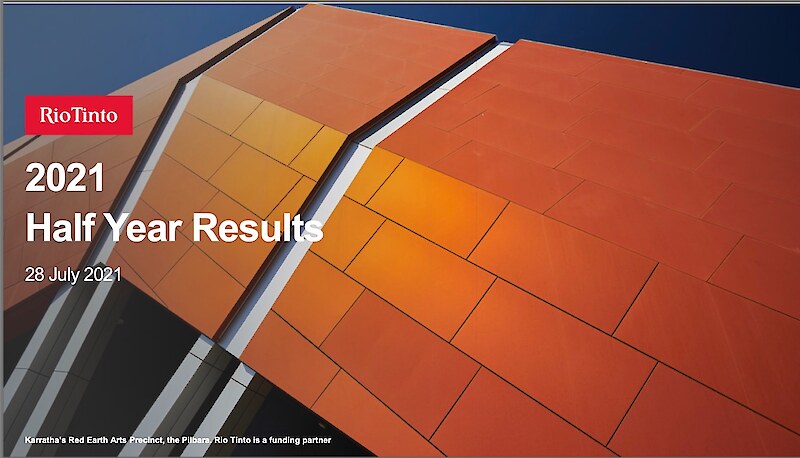
On 28 July 2021 Rio Tinto released it’s Interim Half Year Results for 2021.

The global multi-national mining group has recorded a US$12.1 billion profit for the first six months of 2021 and a record high dividend payout of US$9.1 billion.

Rio Tinto Chief Executive Jakob Stausholm said “Government stimulus in response to ongoing COVID-19 pressures has driven strong demand for our products at a time of constrained supply resulting in a significant spike in most prices. We focused on safely running our world-class assets and supplying products to our customers. This enabled us, despite operational challenges, to deliver record financial results with free cash flow of $10.2 billion and underlying earnings of $12.2 billion, after taxes and government royalties of $7.3 billion.”

See summary slides of Rio Tinto’s Half Year Results 28 July 2021.

What does this mean for Aotearoa and Tiwai?

The Spinoff has published an article written by Bernard Hickey about the role Tiwai had to play in Rio Tinto’s record profits. The price New Zealanders are paying in terms of ‘energy poverty’ is also discussed.

While Tiwai Point’s owner posts spectacular results – crediting dirt-cheap NZ power as a key factor – New Zealanders struggle with high electricity prices that are set to rise even further.

See Bernard Hickey’s article: Why those is energy poverty should be angry about Rio Tinto’s latest results - it’s definately worth taking the time to read.

From the article:

“Rio Tinto, the owner of the Bluff aluminium smelter, noted in its results statement how successful its threat to shut down the smelter late last year had been. The threat led 51% state-owned Meridian Energy to give Rio Tinto a $60m per year electricity price cut, which means the smelter now pays just $35 per megawatt/hr. That compares with the average wholesale electricity price since January, when the price cut was introduced, of $239 per megawatt/hr. The price this week in the lower South Island is $103/mw/hr.

“Lower energy prices, on average, compared to 2020 first half benefited underlying EBITDA by US$43 million, mainly due to lower energy prices at our aluminium smelters, including the new agreement reached during the first half in relation to the electricity supply to New Zealand Aluminium Smelter (NZAS)” Rio Tinto results statement.

Rio Tinto reported this lower price deal had contributed to its record US$12.1b profit in the first six months of 2021 and its record high dividend payout of US$9.1b. It illustrated its “outstanding financial results” slide with a picture of a Bluff Smelter worker. “

Posted: 1 August 2021

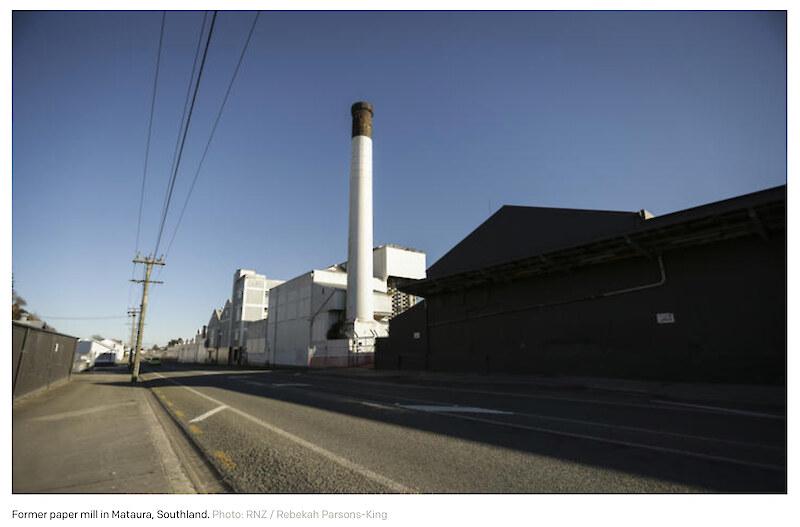
Aluminium dross has been removed from Mataura paper mill

The 10,000 tonnes of aluminium dross that have been controversially stored in an old paper mill in Mataura have now been removed.

Environment Minister David Parker welcomed the news that the last bags of dross were removed from the old paper mill on Wednesday 30th June.

“The safe removal means Mataura residents no longer need to worry about the risk from the material, which gives off ammonia gas if it gets wet.

“I am glad that the dross has now gone from Mataura and local residents do not need to worry any longer. The safe removal will protect the wellbeing of Southland’s people and its waterways.

“Now that the Mataura site has been cleaned up, the focus will move to the removal of material from other known sites in Southland,” Parker said.

Rio Tinto has agreed to pay the $6 million cleanup bill.

The dross is now being stored in watertight shipping containers at the Tiwai Point smelter.

The successful removal of the dross has been a long process, involving Ngāi Tahu, Gore District Council, Environment Southland, the Environmental Defence Society, New Zealand Aluminium Smelters, and Inalco Processing Ltd.

Read more from www.stuff.co.nz; the Otago Daily Times; and Radio New Zealand (RNZ)

Posted: 6 July 2021

Global protest against Rio Tinto 5th June

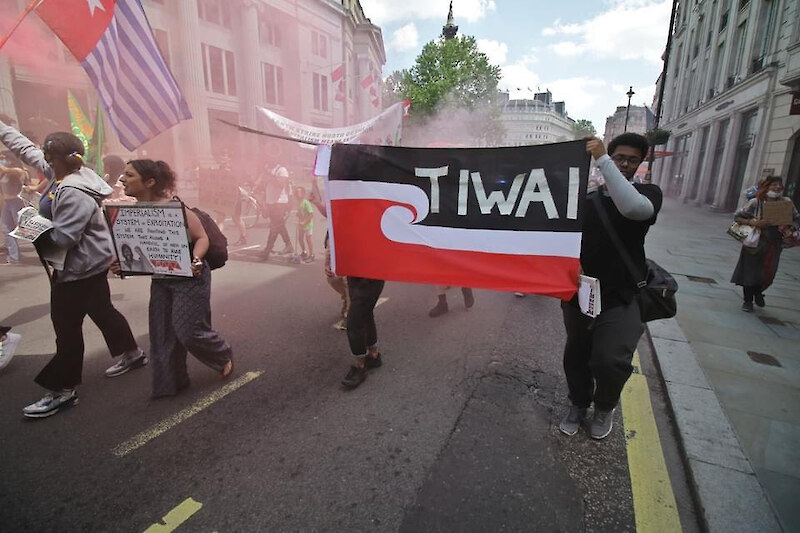
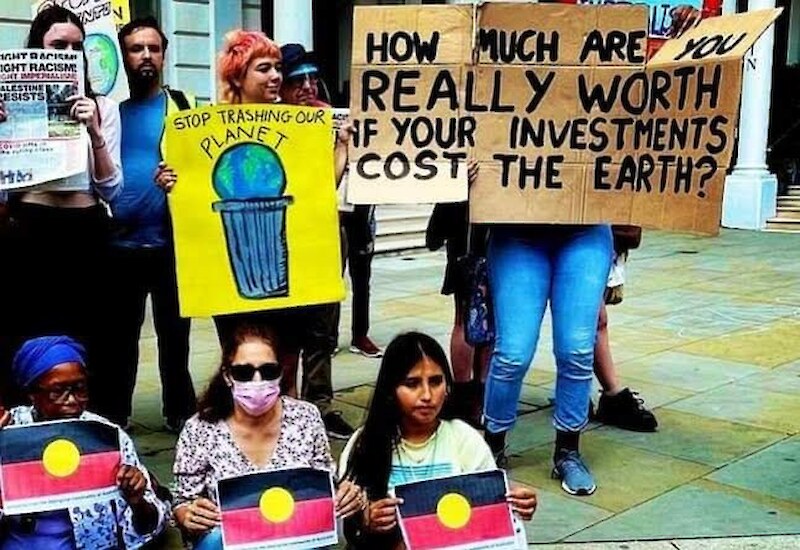
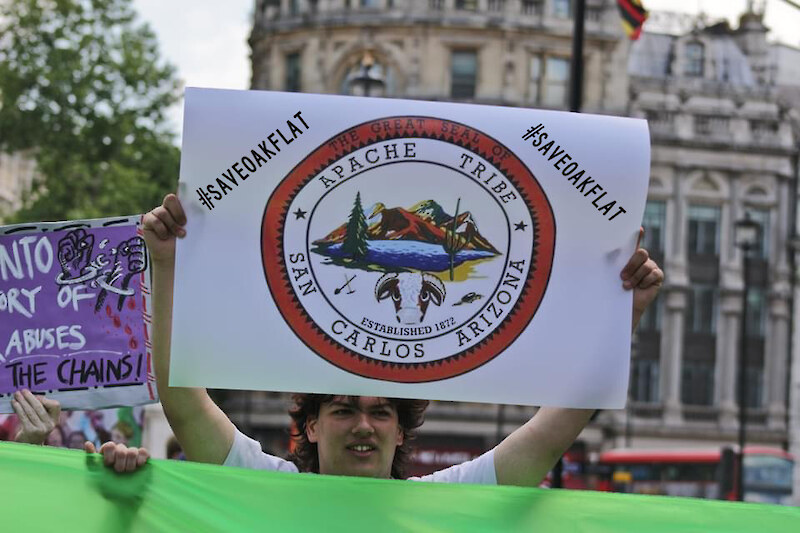
On the 5th of June in South London, a protest against Rio Tinto was led by Earth Strike North of the River from Trafalgar Square to the Rio Tinto headquarters.

The intent was to highlight the breadth of environmental disasters, the displacement of some Indigenous peoples, desecration of sacred sites and ongoing health issues for communities across the planet as a consequence of Rio Tinto’s operations.

Ariana Sutton (Awarua, Waihopai) Rongoā lecturer and traditional Māori Healer, collaborated with Apache Leader and Activist Wendsler Noir Snr to have the Tiwai issue raised on the Tino Rangatiratanga flag and the Apache Nation flag in reference to the ‘Save Oak Flat’ campaign.

The turn out of the protest reminds us just how far, wide and deep the effects of Rio Tinto’s operations have spread and how often solidarity and unification is our greatest strength in confronting such injustice.

Read the Demonstration Speech to find out more about the global effects of Rio Tinto operations.

Posted: 11 June 2021

Prev page
Page 39 of 42
Next page

Also in this section

Pānui updates Photos
  • News
    • Pānui updates
    • Photos

© 2026 Hokonui Rūnanga • Website by RS

Facebook
  • Home
  • About us
    • Who we are
    • Murihiku Regeneration
      • Structure and context
      • Office of Upoko
    • Property assets
    • Find us
    • Job vacancies
  • Our history
    • Our whakapapa - a deep connection to this place
    • Wai and Whakapapa
    • The Battle of Waitaramea
    • Poupoutunoa and Kauwaewhakatoro
    • Two Rivers: Mataura (Mata Ura) and Clutha (Mata Au)
      • Mata Ura - Mataura River
      • Mata Au - Clutha River
  • Events & key dates
    • He Ao Hou - New Futures Murihiku Teacher PD Day
    • Energy and Innovation Wānanga 2024
    • Energy and Innovation Expo 2023
      • He Ao Hou - New Futures Murihiku 22 May
      • Live Streaming of Wānanga 23 and 24 May
      • Hosts and Key Speakers 23-24 May
      • Energy and Innovation presentations - 23 May
        • Opening Addresses
        • Global Session
        • Empowering partnerships: government's role in Aotearoa's energy transition
        • Climate Economics
        • Regional Infrastructure
        • Social regeneration and innovation
        • Regional Innovation
        • The importance of the Māori economy through this change
      • Energy and Innovation presentations - 24 May
        • Regional Leadership Panel
        • Regional Plans and Priorities
        • Southern Green Hydrogen
        • Tiwai Smelter Future
        • Southland Aquaculture
        • Regional Case Studies: Decarbonisation
        • Innovation and Bluff Re-imagining
        • Confirming Priorities: wrap-up and closing
    • Science and Innovation Wānanga 2021
    • Energy, Infrastructure and Opportunities Wānanga 2026
  • Education & training
    • Education - Hokonui Rohe Team
    • Te Ara Aukati Kore - Education, Training, and Capability
      • Kia Tū Pathway Planning Programme
        • Kia Tū in schools
        • Kia Tū Tertiary Pathway Programme
        • Meet Your Kaiako - SIT Campus
      • Anamata Māia: Bold, Confident Futures Service
        • Our Kaimahi - Staff
      • Penapena Ā Kura: School Attendance Service
      • Te Aka Whai Mahi: Find Your Path
      • He Ao Hou: New Futures Murihiku
    • Have your say!
  • Environment
    • Kaupapa Taiao - Hokonui Floriculture
    • Taonga Research
      • Kanakana Research
      • Our research partners
    • Southern Ocean - Murihiku ki te Tonga
    • Energy Transition Programme
      • Regional Energy Action Plan - Towards 2030
      • Energy Transition Plan for Murihiku-Southland
      • Hydrogen and Green Energy
      • Tiwai Point
    • Te Tapu o Tāne
    • Our Kaimahi - Staff
  • Health & wellbeing
    • Whānau Ora Navigators
    • Community youth worker and advocacy service
    • Hokonui Community-Led Health
    • Kaumatua Health Days
    • Te Kakano - Nurse-led Clinics
    • Our Kaimahi - Staff
    • Hokonui Takiwā Health and Wellbeing Village of Support
    • Referral form
    • COVID-19
  • News
    • Pānui updates
    • Photos
  • Contact us
    • Register
  • Facebook
  • Search...